
Today, as Dave and I were busy working on something very, very exciting which we’re looking forward to sharing with you lot in the new year, we stopped for a minute on the 11th hour of Sunday.
Today is Remembrance day, and as ever I made sure that we stop and observe the minutes silence.
For me, these days my thoughts always drift to my Nan, when I would go with her to help sell Poppies during the ceremony in Ipswich. From a child there holding the collection tin, to a young man carrying everything so that my Nan could continue to play her part.
My Nan served in the second world war in the Auxiliary Territorial Service (the ATS) which was the women’s branch of the British Army. Formed in 1938, it allowed over 250,000 women to serve in non-combat roles, freeing up men for the front lines. My Nan was a driver, transporting high ranking members of the forces around in the UK.
Like so many people from that generation, Nan never spoke much about the War, or her service – save the fact it was hard to drive with the blinkers on the headlights, and the fact she went AWOL to marry my Grandfather.
However, one story I did hear from her was her first hand account of the Soham Rail disaster.
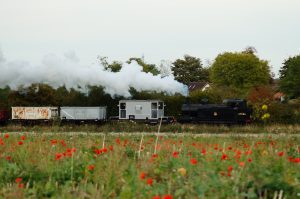
For those of you who haven’t heard of this, on the 2nd of June 1944, a heavy freight train was making its way towards Ipswich. The train comprised of a Riddles WD 2 8 0 Austerity No. 7337, hauling 51 wagons. 44 of these were loaded with some 400 tons of bombs.
As the train approached Soham Station Driver Benjamin Gimbert looked back to see flames coming from the leading wagon.
Thinking quickly he brought the train to a halt, but rather than run for safety he instructed his fireman James Nightall to uncouple the leading wagon – which contained forty four 500 pound bombs – something which you really don’t want to be on fire – from the train, despite the rapidly growing blaze.
Gimbert put the locomotive into motion and managed to get the locomotive and burning wagon sufficiently clear of the rest of the train before it exploded – within Soham Station – creating a crater 66 feet in diameter and 15 feet deep. The blast almost completely destroyed the station buildings, and damaged over 700 properties in the vicinity.
Despite this huge explosion, which killed Nightall, the Guard Herbert Clarke, suffering from the blast and shock managed to walk to the next signal box to warn the signalman of what had happened.
Though this was a huge disaster, the heroic actions of the locomotive crew saved the very town and it’s inhabitants from annihilation, and amazingly the railway was repaired and freight was running again within 18 hours, and passenger services resumed the next day.
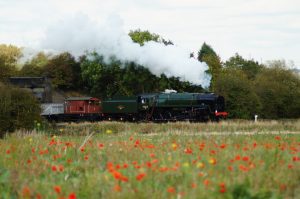
Nan was in Soham, and said she never experienced anything like it. The whole world rocked, and the sky lit up like day. She said that she thought that this was the end.
She, like me lived in Ipswich and was no stranger to the sounds and sensations of falling bombs, Ipswich had a large port after all – but she said this was the first time she was truly terrified.
The fear had been made worse from the fact there had been no warning – normally when bombs dropped the air raid siren would have wailed. There would be the sound of planes, and anti aircraft fire. This was everything from nothing. The silence of night shattered when no one expected it. Being the War, once the noise has subdued and nothing else had happened, it was carry on with her task at hand – the big part being that she was ordered not to speak of what she had witnessed!
It’s a rather sobering thought that if not for the actions of Driver Gimbert, Fireman Nightall and Guard Clarke, that she would have been caught in the explosion of that train going up, and I would not be here musing on the actions that day.
Particularly during today we observe the sacrifices of those on the front line, but we must never forget that it isn’t just members of our armed forces who go above and beyond for the benefit of their fellow man – sometimes it’s someone as humble as a locomotive driver.
For our tomorrow they gave their today